Why Business Partnerships Fail
80%
of Partnerships Fail
Successful companies build growth strategies on partnerships, yet most fail because of avoidable mistakes. Here are the 4 root causes.
REASON 1
Lack of Leadership Expertise
Leaders skilled in sales, not partnerships. Partnerships report to Sales/CRO instead of CEO. Missing understanding of Partnership Readiness.
REASON 2
Unqualified Partners
Inadequate partner qualification processes. Mismatched skills and business goals. Failure to engage commitment and executive sponsorship.
REASON 3
Mistreatment of Partners
Treating partners like customers (Partner ≠ Customer). Limited transparency and trust. No structured partner lifecycle management.
REASON 4
Lack of Applied Standards
No partnership-specific frameworks. Limited adoption of partnership KPIs. Low awareness of standards like ISO 44001.
What Are Partnerships, Really?
Definition
Collaborations between two or more organizations, combining resources, expertise, and market presence to achieve mutual benefits and create value that neither party could easily achieve alone.
The First Principle: 1 + 1 = 3+
✓ Aligned Objectives
✓ Adding Value
✓ Mutual Commitment
✓ Collaborative
✗ Transactional
ACTORS
Supplier ↔ Buyer
Partner ↔ Partner
ACTION
Exchange value for money
Exchange knowledge, create value together
TRUST
Peaks at transaction point
Builds early, stays high until exit
MANAGER ROLE
Close deals, sales metrics
Build relationships, mutual growth
10 Things That Partnerships ARE vs ARE NOT
✗ Partnerships are NOT
1 A quick fix for broken sales motions
2 A way to make others sell for you
3 A "just figure it out" business unit
4 Just another lead-gen channel
5 Measurable by revenue alone
6 A "get" dynamic
7 Transactional
8 Just "integrations"
9 Something you can delegate and forget
10 Owned by your CRO
✓ Partnerships ARE
1 What turns your go-to-market from linear to exponential
2 Built on trust as the starting point, not the outcome
3 Where 1 + 1 = 3 (or more)
4 Your most defensible competitive moat
5 A company-wide commitment, not a department
6 A "give and share" dynamic
7 A recruitment process, not a sales process
8 Requiring executive sponsorship to succeed
9 Collaborative relationships governed by mutual value
10 Long-term investments that compound over time
Achieving Efficient Growth Through Partnerships
⏱
Speed
Accelerate growth
| Partner Category |
Costs |
Efficiency |
Access |
Revenue |
| Channel |
Lower sales &
marketing costs |
Faster sales cycle |
Expanded customer reach |
Increased CLTV, reduced CAC |
| Product |
Lower R&D costs |
Faster time to market |
New client segments |
Increased CLTV, reduced CAC |
| Service |
Reduce operational costs |
Improved processes |
Broader capabilities |
Increased CLTV |
| Marketing |
Shared marketing spend |
Increased engagement |
Greater brand awareness |
Reduced CAC |
Partner Categories, Types, and Business
Three layers of classification. Start by looking at your business functions, then map categories, and finally identify specific partner types.
PARTNER CATEGORIES
Product Partner
Co-development, feature integration, data, better product-market fit
Channel Partner
Revenue generation, reselling, distribution, expand reach, reduce CAC
Marketing Partner
Brand awareness, market education, lead generation, co-campaigns
Service Partner
Logistics, customer support, IT services, operational efficiency
Finance Partner
Capital investment, financial advice, strategic planning
Public Partner
Regulatory compliance, policy advocacy, public sector engagement
PARTNER TYPES
Reseller
VAR
VAD
Distributor
OEM
Affiliate
Referral
White Label
Business Broker
Technology Partner
ISV
Data Partner
R&D Partner
SI
MSP
Solution Partner
Content Partner
Brand Ambassador
Agency
Consulting Firm
Business Angel
Venture Capital
Strategic Investor
Joint Venture
Industry Association
Government Agency
Regulatory Partner
Partner Categories describe the broad strategic contribution a partner makes to your business functions. Partner Types describe the specific operational role a partner fulfills within a category. Partner Business is how partners describe their own activity (e.g. Agency, Consulting Firm).
Are You Set Up for Partnership Success?
1
Leadership Commitment
Without strong leadership commitment, partnerships quickly lose direction, resources, and support. Top-level commitment only works if clearly communicated.
Is your leadership on board?
2
Expectations & Goals
Partnership goals must link to overall business goals. Timelines must be realistic. The rules of transactional relationships do not apply here.
9-18 months to see results
3
Business Growth Stage
Not all partnerships work at every stage. From StartUp to Enterprise, different partner categories fit differently as your company expands.
Match partners to your stage
4
Partner-to-Market Fit
Builds on Product-Market Fit and Go-to-Market Fit. Assess product readiness, sales processes, pricing, and channel readiness before partnering.
PMF + GTMF + PtMF = Partnership ready
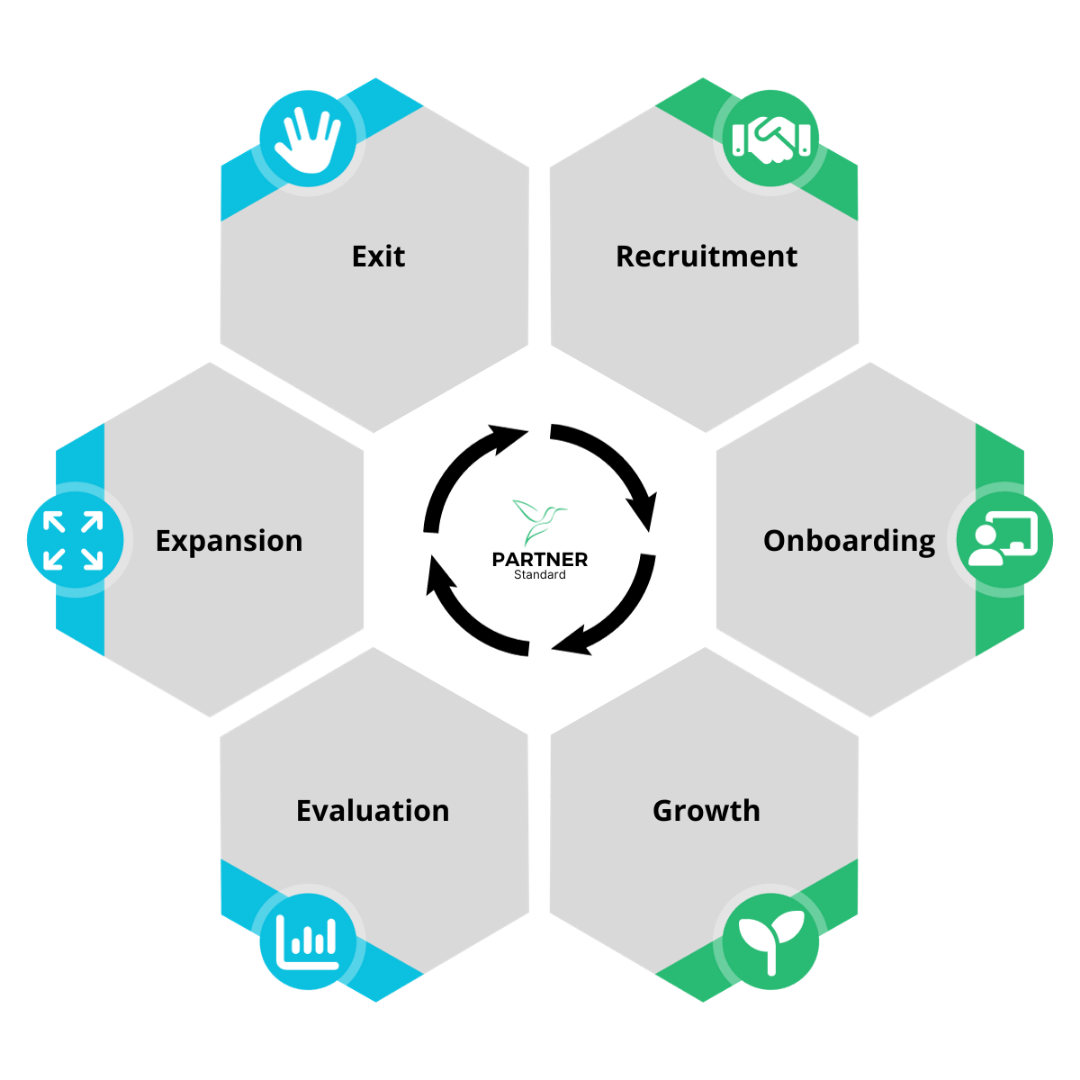
The 6 Stages of the Partner Life Cycle
1
Recruitment
Partner Value Proposition
Ideal Partner Profile
4C Qualification
Mutual Action Plan
2
Onboarding
Maintain momentum
Structured kick-off
Like onboarding an employee
3
Growth
Role of marketing
Success through collaboration
Executive sponsorships
4
Evaluation
Performance Pyramid
Preferred Partner Program
Growth Evaluation Loop
5
Expansion
New markets & segments
Strategic partnerships
Expansion planning
6
Exit
Exit triggers
Exit strategy activation
Graceful conclusion
KEY INSIGHT
Signing a partnership agreement is the beginning of a long journey, not the end goal.
THE DILEMMA
You live with someone else's hiring criteria, sales team, culture, and compensation plan.
YOUR POWER
Focus on disqualifying, not qualifying. You meet partners on eye level. Partner ≠ Customer.
Recruitment: Qualification & Alignment
4C PARTNER QUALIFICATION
4C
Customer
"Do they reach the right customers?"
Overlapping target market. Access to new segments, industries, or regions.
Credibility
"Are they trusted in the market?"
Brand reputation. Industry expertise and thought leadership.
Capability
"Can they actually deliver?"
Technical skills and resources. Sales and marketing capacity.
Commitment
"Will they invest in this?"
Executive sponsorship and buy-in. Dedicated resources.
MUTUAL ACTION PLAN (MAP)
Your most powerful tool for partner success. It transforms vague partnership intentions into concrete, accountable actions. Define what success means together from day one.
Objectives The partners' objectives for the partnership
Activities to Promote the Partnership Joint actions that drive value together
Stakeholders & Responsibilities Who owns what on each side
Milestones & Timeline Key checkpoints and when things need to happen
Agree on a MAP as early as possible. Use it through recruitment, onboarding, growth, and evaluation.
KEY PRINCIPLES FROM THE COURSE
"The acquisition of new partners is not a sales process. It's a recruiting process."
PARTNER LIFECYCLE
"Your product isn't the star of the show. What captures a partner's attention is how collaborating with you will elevate their own business."
PARTNER VALUE PROPOSITION
"Qualifying the right partner is an upfront investment. Dealing with the wrong one is an ongoing expense."
RECRUITMENT / 4C METHOD
"Spend the same time and effort to onboard a partner as you would do for an employee."
ONBOARDING
"You will miss the party if you keep staring only on the revenue figure. Partnerships impact your business beyond revenue."
PARTNERSHIP FUNDAMENTALS
"You can't scale alone. There is nothing more powerful as an idea whose time has come."
WHY PARTNERSHIPS NOW